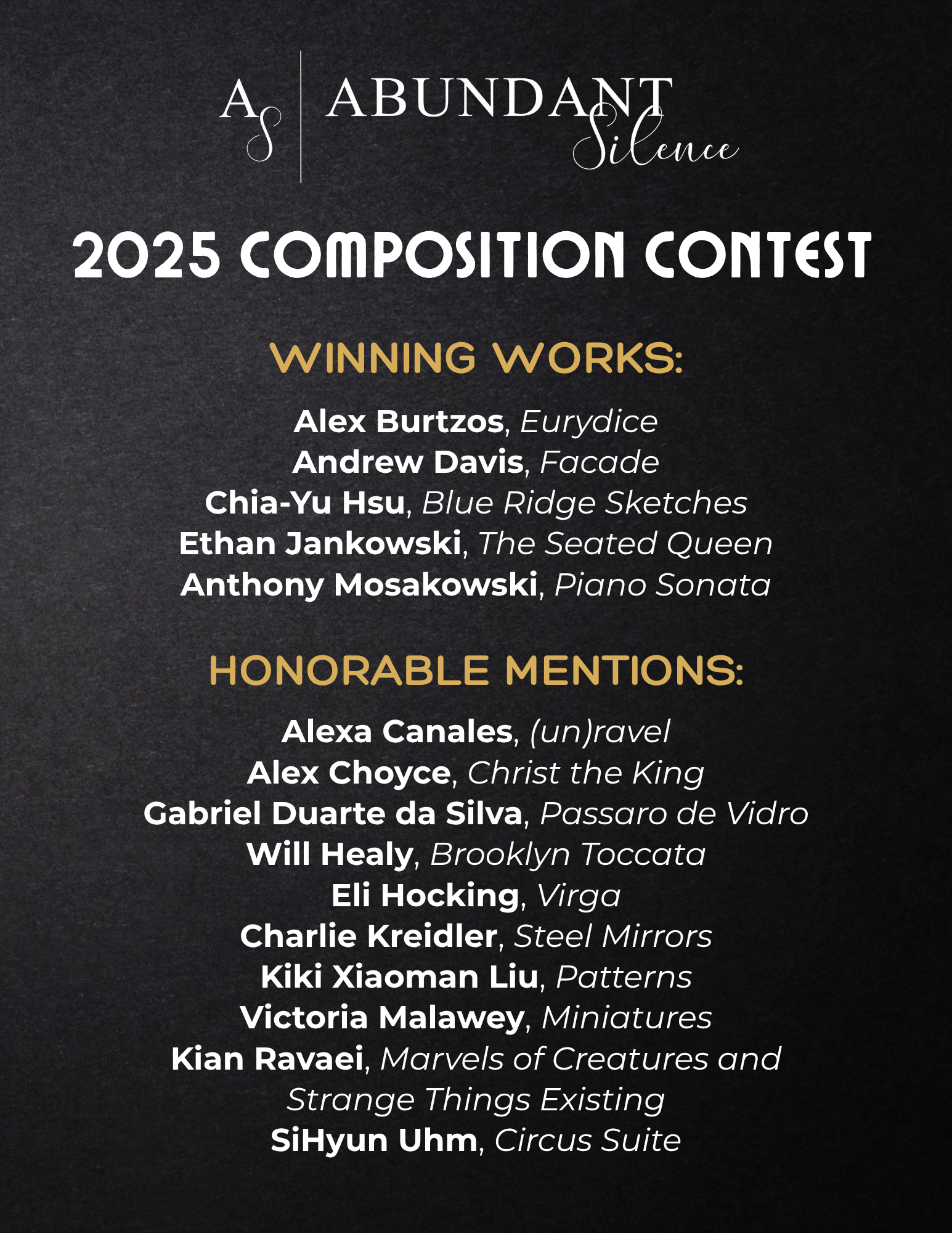
2025 Composition Contest Winning Works
This past year, I have had the honor of organizing Abundant Silence’s new composition contest, in conjunction with the Festival for Creative Pianists and FOCAM. I am deeply grateful to my fellow judges—Aaryn S. Ricucci-Hill, Ayumi Okada, Luke Rackers, and Dayton Kinney—without whom this competition would not exist.
I would like to take this opportunity to elucidate our methods of judging. Although we only anticipated 100-150 applications, we were both shocked and thrilled to have received works from over 300 composers after our October deadline. This underestimation led us to quickly adjust our judging methods—each of the five judges was randomly assigned a pile of about 70 works, from which each judge needed to select three to advance to the final round. These fifteen finalists were the subject of an over 2-hour long meeting in which we discussed each of the works in excruciating detail, diving into the intricacies of musical structure, musical notation, and creative intent. At the end of this discussion, each judge made our case for our top works, culminating in a silent and anonymous vote. Each judge voted for five winning works, and each work that received three or more votes was selected as a winner.
Each of the winning works is singularly unique, and demonstrates each composers’ individual approach to piano composition.
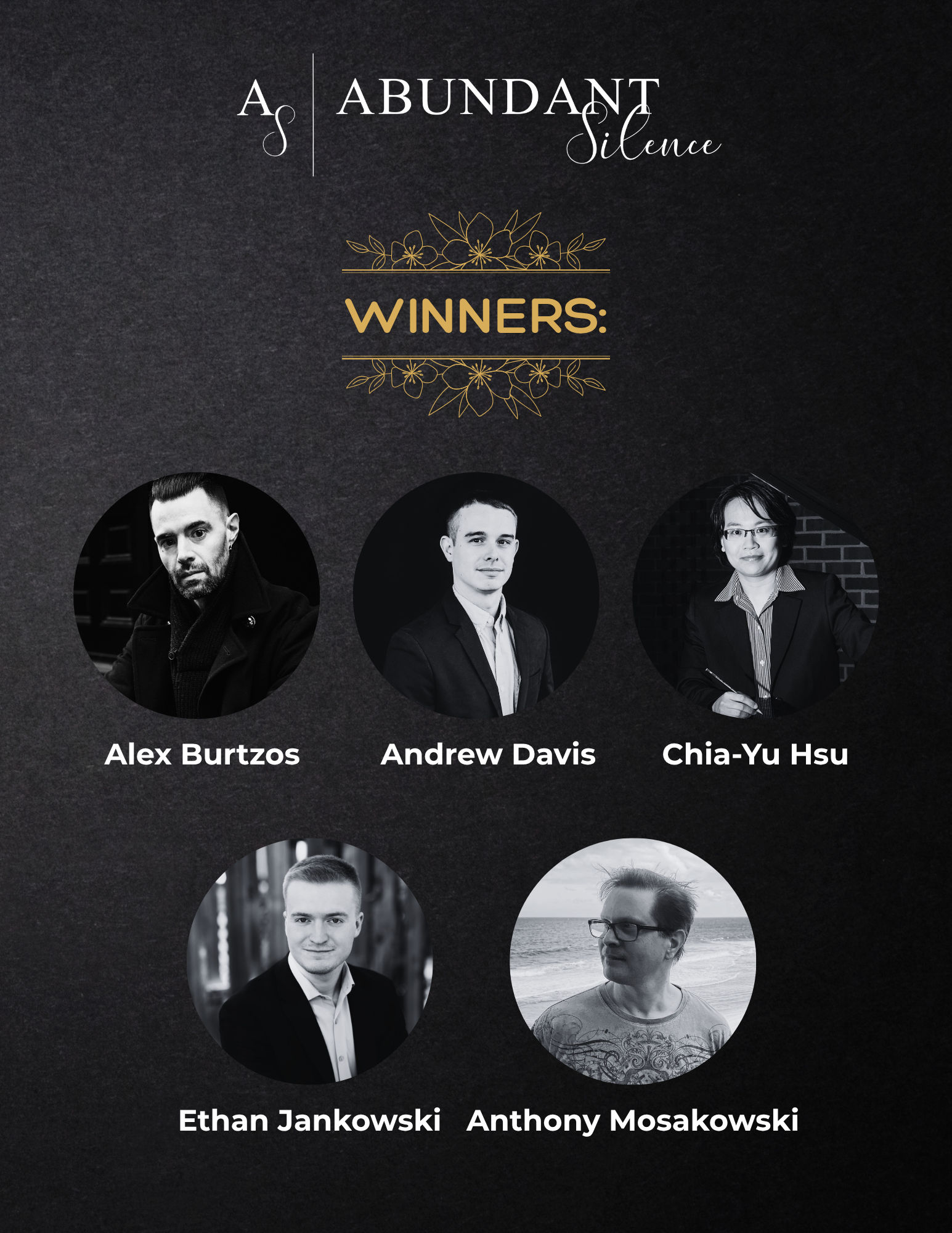
Alex Burtzo’s Eurydice charmed us with its intense emotional depth and fantastic musical development. The inventive, contrapuntal development of the four-note theme lends itself to a moving musical dialogue.
Andrew Davis’ Facade captivated us with its beautiful harmonic language and unique blend of musical genres. The subject matter of the piece represents a powerful connection to music which resonates with a wide audience.
Chia-Yu Hsu’s Blue Ridge Sketches enchanted us with its beautiful musical atmospheres, and the scenic imagery it evokes. The work is wonderfully pianistic and makes great use of the entire timbral range of the piano.
Ethan Jankowski’s The Seated Queen impressed us with its otherworldly soundscape, created through the use of carefully mapped piano harmonic effects. The score is eye-catchingly beautiful, and is a testament to the composer’s attention to detail within his artistic practice.
Anthony Mosakowski’s Piano Sonata allured us with its creative interpretation and expansion of a traditional classical form. The work drives forward with a distinctive rhythmic excitement, leading to an exciting listening experience
Myself, and the other judges were blown away by the quality of work we reviewed, and found narrowing down to only three selections to be a Herculean task. We are hard at work getting each of the winning works ready for publication, and we are looking forward to our next competition!
-Brady Wolff, Board Member